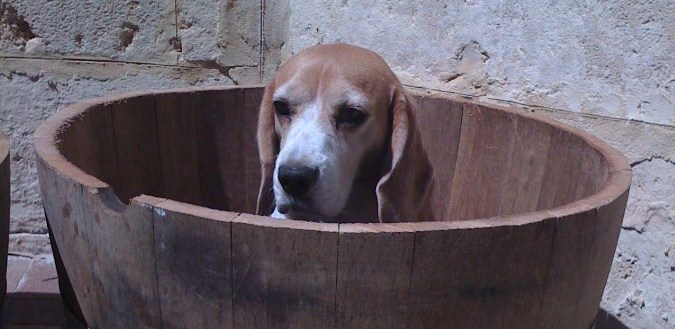
My very own garden beagle

My very own garden beagle
Some people have gnomes... I have beagles

Wednesday, 21 August 2013

A bucket of slaters

I've been having trouble growing anything from seed. As soon as my pea shoots clear the soil, they're chomped off. Same with the radishes, leafy greens, beans etc. They only thing that isn't being routinely eaten is my coriander. It turns out over winter I created the perfect breeding ground for slaters. I always thought they were quite harmless little critters, but in large quantities they are weapons of mass garden destruction! I have set out to eradicate them. Unfortunately, it's not easy. Again, it's one of those things that can be controlled with noxious chemicals that you wouldn't want anywhere near your food crop. I recently heard you can create a barrier with lime and sawdust mixed together to protect certain plants. But I have chosen an old remedy. Oranges!


I am drinking a glass of freshly squeezed orange juice every day and forcing my husband to do the same. The leftover half oranges go into the garden, skin side up. This orange I put out in the garden about an hour ago, you can see the slaters starting to gather around it already:


Each day I look inside the orange halves and hundreds of slaters have gathered underneath them.


Then I tip them out into a bucket:

 
After a week of this, there must be thousands of slaters in my bucket. I heard an experienced horticulturist once say he doesn't think worm farms are very good, so he built a slater farm to help compost his scraps. Wish I could give him my bucket of the little destroyers. You could feed them to your chooks, they'd love them... or a neighbours' chooks! I have no idea how long I am going to have to keep squeezing oranges for, but I think the population is starting to reduce! And my vitamin C levels are great!

Wednesday, 14 August 2013

Garlic maths


At the end of March I planted some garlic. 'Some' turned out to be about 150 cloves of garlic. So now I have about 150 strapping garlic plants that are just months away from harvest:


It's looking really good. Some of course are bigger than others and seeing as I bought bulbs from two different people and then received a bowl of homemade-grown garlic from my Italian neighbour, I have no idea which is which. I might just have to wait and see and then save the biggest to replant next year. I will take my harvest queue from my neighbour, who told me when to plant. her garlic looks amazing, the plants are the size of leeks! But I'm happy with the way mine are going compared to last years sad lot that were planted too late into sand and only grew one small clove each!

I now need to calculate how many I need to keep for a year of garlic in the kitchen and how many to save to replant!

Friday, 2 August 2013

Meanwhile, on the verge...


You may remember that less than a year ago, we transformed the half dead and compacted patch of grass on our verge into this:


Then we added some pine bark and planted out some low-growing Australian native plant tube stock (scaveola, conostylis, grevillea, kangaroo paws) and it looked like this:


Well, nine months later the plants have grown, we lost a few and along the way we've planted some more here and there (knobby club rush, cushion bush, pimlea, banksia) and now it looks like this: 


I'm ready to add some more bird-attracting plants while we're getting good rains to help them settle in before summer. (banksia blechnifolia, eremophila Amber Carpet and decipiens, eutaxia obovata or bacon and egg plant, grevillea gingin gem and kangaroo paws Mangles and Pink Beauty) I expect that in another 12 to 18 months our verge will be a carpet of flowering native plants. Here's my tube stock:


Not only are the plants beautiful, they will provide a much-needed food source for native birds and bees in the metropolitan area. On top of that, I will hand water them through their first couple of summers and after that, they should be able to survive on rainfall alone. The tube stock, although small, does grow quickly and tends to settle in better than more established plants.
 
It's really important to provide food and habitat for our native animals and insects in the city. Imagine if every 10th house on our streets replaced their patchy, unmowed, ugly, water and fertiliser-guzzling lawn with a native verge garden. It would be like having thousands of acres of bush reserves in our cities. That could only be a good thing for our environment right?
 
Now, if I've inspired you to plant out your own native verge, even if it's just a couple of ground-covering grevilleas and a few kangaroo paws, stay tuned for my next post on how best to plant your tube stock!

Thursday, 25 July 2013

In the lime light

About two years ago I planted one of the CSIRO's Australian Red Centre Lime trees in a half wine barrel. I thought I was getting an Australian Finger Lime, the ones where the centre of the fruit comes out like caviar. I thought that would be marvellous with fresh oysters, sprinkled on mini lemon tarts or in cocktails. Well, it turns out my lime, and the one I thought I was planting, are completely different plants! Oops.
This year the Red Centre lime had a bumper crop as you can see below:


The fruit is tangy and tasty, but it would take a lot of work and a very small juicer to squeeze enough for an evening of margaritas! I am keen to try some of the fruit thinly sliced and placed on top of white fish fillets, then baked in the oven. But for now, I had a small bucket of fruit to use.
What to do with them? Well, an idea came to me at the weekend, while we were sausage-making with our Italian neighbours and shared an amazing lunch of home-grown and home-made delicacies and heard stories of life in Italy and what it was like coming to Australia on the boat. The conversation turned to grappa and what it was good for. My husband suggested the only thing it was good for was cleaning drains. But our hosts said they pickled kumquats in grappa and sugar. The Red Centre lime is about the same size as a kumquat and it got me thinking. What about lime-infused tequila, or vodka? (...or grappa for those who are brave enough)


So I put my rain jacket on this morning and while the beagles snuffled for dog biscuits I'd scattered over the paving, I picked the limes. After washing and slicing them open, I put them in boiled jars, topped some up with tequila, some with vodka and one lucky one with grappa and sugar. The I added these super-cute 'jar bonnets' that my friend gave me and there you go, pickled limes, ready to taste in 6 weeks:


I'm not sure what I'm most excited about... a glass of the lime-tequila on ice, or trying a lime-vodka martini? Of course, the limes won't be wasted... I think I'll still use them on fish or maybe in a dessert. I'll let you know how it works out. Maybe I will still find room to plant an Australian finger lime to add to my lime tree collection?

Sunday, 16 June 2013

Holiday gardens!

While I have no idea how my own garden is going back home, I've found plenty of time on my holiday to enjoy some other gardens!

Here in London, our special friend Greg organised to take me to the Royal Botanic Garden at Kew.  We have been there before of course, but he thought I would like to see their latest exhibition - Incr-Edibles! They had some fabulous displays like this garden below fashioned just for the exhibition:


They also had a garden party set up, with all the herbs growing in the bowls and pots:


We walked for about an hour to see an exhibition titled 'Bouncy Carrot Patch' which sounded like fun. We were disappointed when we finally found it - a patch of mulch cordoned off with some construction webbing with an apology stapled to it!

The gardens are spectacular. They are trying to get people not just interested in growing vegetables for themselves, but educating them about where vegetables come from. I heard more than one adult asking what some of the plants were. Plants they should have been able to recognise from the food they put on their tables! I was surprised.

I have some more photos to post soon... Not just a crack plant, a crack TREE! 


Tuesday, 28 May 2013

Time to rest!

Remember my nematode problem? I can't forget it! I've been trying to 'cure' my vege bed of root knot nematodes. I planted a mass of mustard seed and let it grow for a few months, until it was just starting to flower. The other day I slashed it down. Here is my progress slashing photo:


After I slashed it, I dug it into the soil which I will keep it moist while it breaks down. As the mustard decomposes, it releases a gas the nematodes don't like. The slashing and digging was hard work, I'm not going to lie. I also sowed some more mustard seeds, so they can grow over the next month and I will slash and bury them as well. I spread some sheep manure and Piggypost before I covered it all up with lupin mulch.

Today I tried another remedy. Apparently the nematodes don't like molasses. So I mixed up molasses and water in a watering can and poured it over the garden bed:


I've read that the sugar can kill worms and good critters in the soils as well. To remedy that, I have some Troforte ready to spread in a few weeks to encourage the good guys back to the soil and the compost in my two compost tumblers will be ready by then as well, so that will help:


Anyway, while my garden bed and my compost have a rest, so will I! I'm off on a holidays for a few weeks so my next blog will be from the road... maybe a bit of foreign garden inspiration!

The Beagles are also exhausted from all the gardening and are looking forward to their holiday:


Sunday, 26 May 2013

Living on the edge

I’m convinced that growing in my front garden brings a sense of community to my neighbourhood.  The mornings I’m out in the garden I hear a cheery “Good morning neighbour!”  from across the short expanse of road. “Lovely day for gardening!”
My husband has a theory that the introduction of water restrictions has caused a decline in neighbourliness. He thinks back to when he was younger and people used to stand around on their front verge, with a tinny or a glass of West Coast Cooler in one hand and the hose in the other while they watered their verge lawns. It would be a good time to catch up with the bloke over the fence and you’d know if something wasn’t right with your elderly neighbour across the road if they weren’t to be seen watering their verge for a couple of days, so you’d go and check in on them.
When I’m in my food garden or on the verge planting natives, drivers slow down and wave as they pass. In the past week I’ve met two neighbours who drove up their laneways, then came back on foot to introduce themselves and have a chat about things.
Yesterday, while waiting for her husband to drop something off, a woman got out of her parked car and wandered right into my garden and started chatting. She was most impressed with my herb patch and told me all about the exotic fruit trees and vegetables growing in her backyard not far from here that she inherited from a previous owner. She spotted my Thai basil and gave me some tips on how to use it. She was cooking bolognese for her two boys that night, so I sent her home with a bunch of sage, basil and thyme and she was delighted. How often can you make a stranger happy by something so simple? She told me she’d pop back and drop off some sugar cane for me to plant.
And you know what? She did! The next evening, she ran down my driveway with a bag of sugarcane. She also brought some seeds from a fruit in her back yard that she said was delicious, but she didn't know what it was called. She said if I had any success with the seeds, she'd love me to drop one of her plants back to her!