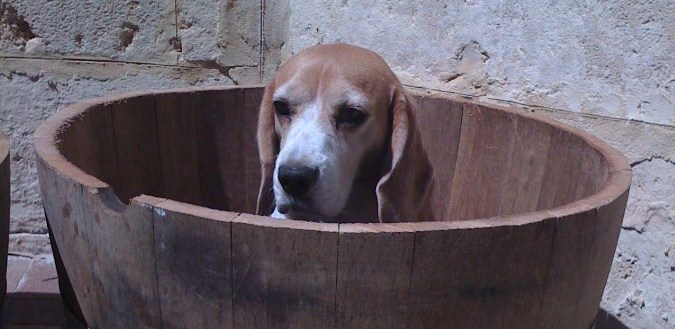
My very own garden beagle

My very own garden beagle
Some people have gnomes... I have beagles

Saturday, 11 January 2014

A frangipani of my own

Happy new year!
 
I hope you're looking forward to a year of garden adventures and maybe I can provide a little inspiration along the way.
 
The vegetable garden is coming along nicely and surviving the heat, we're eating corn, zucchini flowers and lots of cucumbers. I planted my tomatoes really late, so they are just coming along now and I'm making basil pesto as the plants grow out of control. The beagles have been out hassling lizards and finding cool patches of dirt to lay in.
 
To start 2014, I thought success story might be just the thing to share with you.

You may remember in April last year, I tried to overcome my frangipani envy by planting some cuttings.

I went against online advice and planted tall cuttings in the hope I could get bigger trees, faster.

I am really pleased to show you that the cuttings all took... I have three flowering, flourishing trees! They are already about 1.5 m tall and spreading their beautiful perfume around my courtyard.

Here's one of them:


This was me in April collecting the prunings from a friend's tree:


Considering the price of frangipanis this size in a nursery, I think I did pretty well. And my friend had better watch out because I'll be coming back for more cuttings as I plan my back garden. But, that's a different project I will keep you up to date with!

Monday, 21 October 2013

Bug city


A few months ago I decided to plant some flowers throughout my food garden for a few reasons. Firstly, because they're pretty and I can cut them and bring them inside. Second, because I was frustrated at the nematodes and thought if I can't grow vegetables, what can I grow? And most importantly because they attract insects into the garden. Bees for pollination and everyone should be doing all they can to keep bee populations healthy while insecticide sprays on crops are wiping them out and they are vitally important to food production. (rant over) Also all the other bugs we have keep a neat ecosystem going so that no one type of bug will take over and destroy crops.

Here's some of the bugs visiting my garden over the past week;


I have a couple of spiders that I like to leave in the garden. I threw a slater into his web. The spider didn't seem too interested in it, sadly.


And this mantis was about 5cm long and was trying to hitch a ride around on my arm the other day. I haven't seen one of these so big since I was a kid. I hope he eats slaters.


Tuesday, 15 October 2013

Beans!

 
My first broad beans of the season:
 

They're a little bit late. I know this because my neighbour has picked, podded, frozen and dug the remains of hers back into her soil already and planted out tomatoes on top of where they were. I only have a small patch, mainly because I don't like broad beans all that much. Until now. My experience of broad beans in the past has been giant beans with the outside a kind of grey colour and boiled to a soggy mass. I have decided that if you pick the beans really young, they are sweet and delicious!

 
For dinner the other night we has this delicious broad bean bruschetta, an adaptation of a Donna Hay recipe. We brushed slices of sour dough with olive oil, grilled them, then rubbed them with a clove of raw garlic, like you would for bruschetta. Then spread on some soft fetta, topped it with beans quickly blanched in boiling, salted water and then sprinkle dover some gremolata (finely chopped parsley with lemon zest). It was really tasty and the beans were delicious;


Even Mustard thought it looked pretty good and insisted on watching us eat every single bite with a mournful expression on his face!
 
I'm now watching closely for the next lot of beans to grow to the right size for picking!

Sunday, 6 October 2013

It's cactus!

Gardening isn't for everyone. And when all else fails you can try this:


I picked up this fantastic knitted cactus at a craft fair in Perth recently. I know it's not a real indoor plant, but at least I can't kill it! The beagles probably could if they got their teeth into it, though!

Sunday, 22 September 2013

Magnificent magnolia


How amazing is this magnolia? It belongs to a neighbour of mine and it's so beautiful I had to take a photo of it a couple of weeks ago.


I didn't even know I could grow this sort of magnolia in my area of Perth. I wonder if the gardener has created the perfect microclimate on the other side of the ivy-covered fence for it? I'd love to explore the rest of his garden!
It's this time of year I promise myself that I will plant my leisure garden (the backyard, as opposed to the food garden in the front yard) with flowering deciduous trees.
From our backyard we have a view of a row of ornamental plum trees and a flowering pear planted in our neighbour's yard. Up the street is an almond tree that spreads drifts of petals up and down our street like confetti.
And of course, down the laneway is the beautiful magnolia tree. Here's a photo I took more recently of the same tree:


All these trees are losing their flowers and the greenest of green shoots are appearing everywhere, a sure sign spring is here. Now I have my heart set on planting some of these trees in my yard so that every day while I eat my breakfast I can watch their bare branches burst into bloom, watch the petals littler the ground and then watch as spring turns them green again..

Sunday, 15 September 2013

Back to my roots

Growing up on the farm I spent many childhood days picking mallee roots. We'd head to a paddock that was going to be cropped and hurl the dry, gnarly roots into small piles. Then Mum or Dad, or later my siblings or I would drive the 'ute', a thundering F100, around the paddock. We kids would be standing on the sideboards or sitting on the tailgate as we made our way from pile to pile. When we got to each pile, we'd all jump off and throw those mallee roots onto the back of the ute before jumping back on the running boards and heading to the next pile.

The mallee roots of course would be unloaded into our wood pile and used through winter to light the fires to keep us warm, light the kitchen stove and heat our water.

I don't have a big open wood fire in the city, and I certainly don't have a wood stove or water heater, but I still have a use for those mallee roots.

My wonderful Mum and Dad were coming up from the farm last week, so I asked if they would mind bringing me a couple of old, weathered mallee roots for my native verge garden. See how good they look:


They already look right at home among the kangaroo paws! The good thing about using the rocks and roots in this garden is that it gives it some structure, so even when it's not all flowering, it looks like a vaguely naturalised scrub.


It also gives the little lizards somewhere to play and hide. I look forward to watching all my tiny plants grow up amongst them.

Wednesday, 21 August 2013

A bucket of slaters

I've been having trouble growing anything from seed. As soon as my pea shoots clear the soil, they're chomped off. Same with the radishes, leafy greens, beans etc. They only thing that isn't being routinely eaten is my coriander. It turns out over winter I created the perfect breeding ground for slaters. I always thought they were quite harmless little critters, but in large quantities they are weapons of mass garden destruction! I have set out to eradicate them. Unfortunately, it's not easy. Again, it's one of those things that can be controlled with noxious chemicals that you wouldn't want anywhere near your food crop. I recently heard you can create a barrier with lime and sawdust mixed together to protect certain plants. But I have chosen an old remedy. Oranges!


I am drinking a glass of freshly squeezed orange juice every day and forcing my husband to do the same. The leftover half oranges go into the garden, skin side up. This orange I put out in the garden about an hour ago, you can see the slaters starting to gather around it already:


Each day I look inside the orange halves and hundreds of slaters have gathered underneath them.


Then I tip them out into a bucket:

 
After a week of this, there must be thousands of slaters in my bucket. I heard an experienced horticulturist once say he doesn't think worm farms are very good, so he built a slater farm to help compost his scraps. Wish I could give him my bucket of the little destroyers. You could feed them to your chooks, they'd love them... or a neighbours' chooks! I have no idea how long I am going to have to keep squeezing oranges for, but I think the population is starting to reduce! And my vitamin C levels are great!